Overview
Nuclear medicine is a specialized branch of diagnostic and therapeutic medicine that uses medically approved radioactive tracers called radiopharmaceuticals for evaluating organ functions and for diagnosis and treatment of diseases.
Diagnostic modalities in Nuclear medicine department include high quality, state of the art SPECT with 32 slice diagnostic CT which is India’s first of its kind and PET/CT scanner with Time of flight (TOF) technology. These imaging modalities can assess abnormal organ functions (usually with SPECT scans) and identify several diseases early in its course, even before the conventional imaging. PET scans are indispensible for diagnosis, staging, treatment and recurrence evaluation of cancers thereby providing better clinical outcomes. All these investigations are safe without significant adverse effects. It can be used in all age groups except for pregnant patients and in some breast feeding patients.
Nuclear medicine also provides treatment options by killing the abnormal cells using therapeutic Radioisotopes (Beta and Alpha therapy). These are mainly used for hyperthyroidism, and cancers like thyroid, prostate, Neuroendocrine and liver (TARE). These are therapies are usually with no or mild side effects which can be managed conservatively.
Department of Nuclear medicine in Amala hospital offers high quality diagnostic and therapy services with state of the art infrastructure, highly trained doctors and support staff.
OPD timings for consultation: Monday to Saturday: 11 am to 3 pm.
For enquiries and appointments Please contact: 9526670007 (PET/CT), 0487 – 2304163, 9778968558 (SPECT/CT) (8:30 am – 4:30 pm)

PET-CT Reception
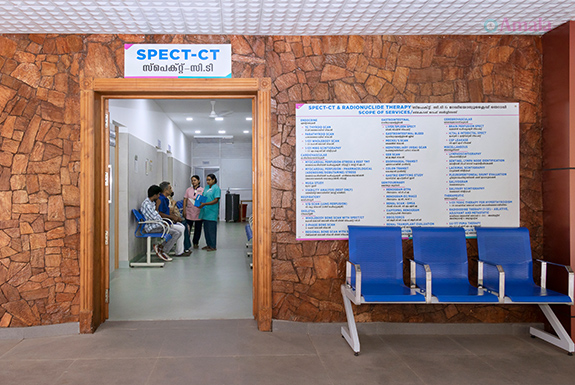
Department of SPECT-CT
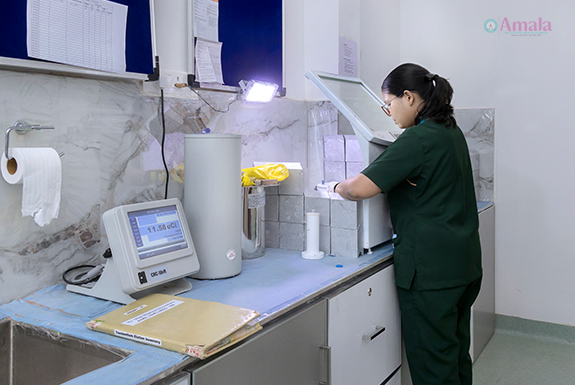
Radiopharmacy laboratory
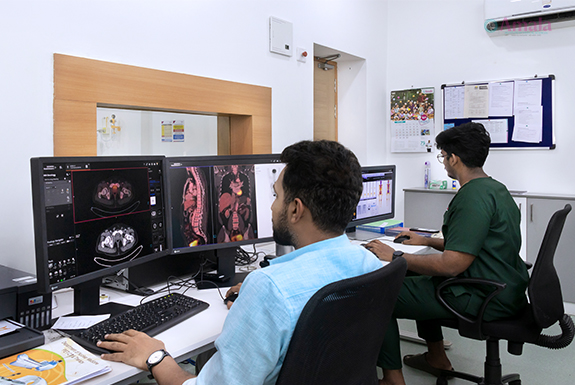
Console (SPECT/PET)
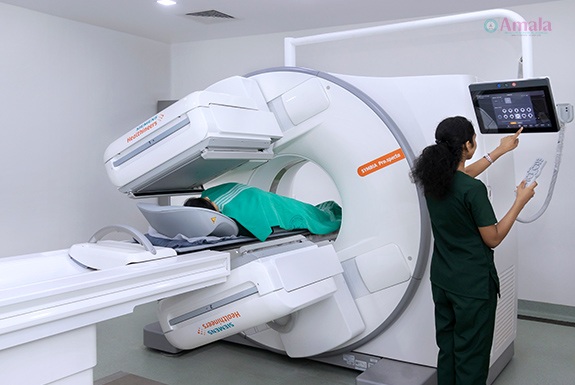
SPECT-CT ( Siemens symbia Prospecta Q3)
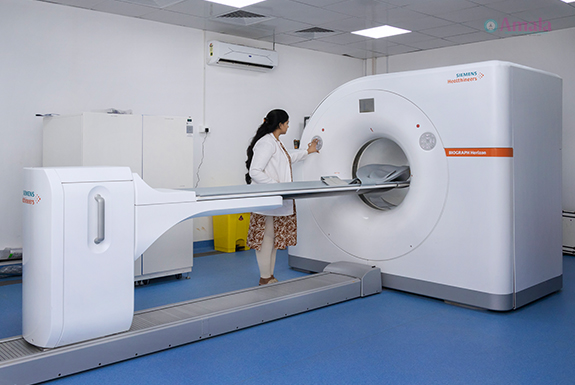
PET-CT (Siemens Biograph Horizon)

Department of Nuclear Medicine
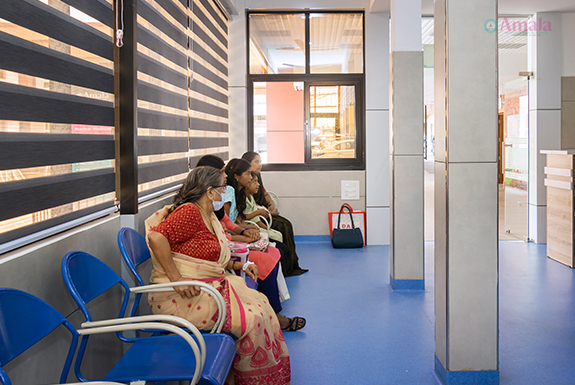
Waiting area
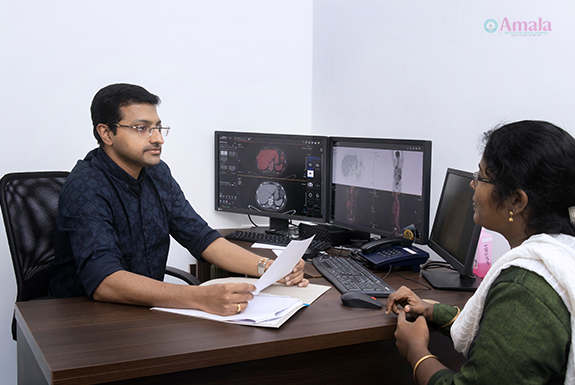
Consultation room
Endocrine
Cardiovascular
Respiratory
Skeletal
Gastrointestinal
Genitourinary
Cerebrovascular
Miscellaneous
Therapeutic
Monday to Saturday: 11 am to 3 pm.
Nuclear medicine is a specialized branch of medical imaging where it uses small amounts of radioactive materials to study how your tissues and organs are functioning. It can reveal changes in biological activities, while normal scans show body structures. A nuclear medicine hospital in Thrissur may use these techniques to investigate specific conditions.
A PET-CT scan combines images of the body's structure with information about tissue activity. Doctors use it for selected conditions, particularly to assess certain cancers and understand how disease is behaving.
A cancer patient might need PET scan for mapping out the biological and metabolic activity of cells inside the body. A PET scan for cancer can help doctors assess how far certain cancers have spread, check treatment response, or investigate possible recurrence. PET scan is not required for all cancer, the decision is only made after the patient’s diagnosis.
The PET scan itself is completely painless and non-invasive. You will receive an injection containing a radioactive tracer and lie still while the images are taken, this will be the discomfort you might face. The team at Amala will clearly explain how to be prepared and what to expect.
For many PET scans, fasting is required. Before some scans, you might be asked to not do any difficult exercises. The instruction and preparation vary with the tracer used, so it’s important to follow what the nuclear medicine team says.
Molecular theranostics combines diagnosis and treatment using specific biological targets. In selected conditions, doctors can use targeted imaging to identify disease and then consider a related treatment directed at those same targets.
Yes, diagnostic nuclear medicine scans are typically considered safe medical procedures. These scans use carefully controlled amounts of radioactive material. Only when the expected medical benefit is on a satisfactory level does the doctor recommends nuclear medicine scans.